Showing posts with label Rupert Everett. Show all posts

Wednesday, 11 September 2019

Theatre Review: Uncle Vanya at Theatre Royal Bath

This review was first written for British Theatre Guide


The misery Chekhov’s Uncle Vanya traditionally wrings from the boredom and isolation of rural life is undermined in this new adaptation by David Hare. From looking into the claustrophobic living area, at the end of the first act, perspective shifts outwards towards the horizon, affording a view of such tranquillity that any flagging human heart would surely be stirred. Yet, although some of his decisions as a director may be questionable, Rupert Everett’s impassioned performance in the title role is fascinating to watch.

His Vanya seems set apart from his peers, vital and imposing with a generous moustache and dark belted tunic. By all appearances a man of great appetites, it’s unlikely he would be a stickler for sensible routine, even if he has been worn down by years of conformity. Still, the play’s beginning finds him drunkenly collapsing on a makeshift bed, exhausted by the demands of entertaining his brother-in-law Professor Serebryakov, who is visiting with his beautiful new young wife Yelena.

Everett’s interpretation mines a self-deprecating humour in the misery of his situation, railing against Serebryakov’s professional mediocrity as an ‘artistic bed-blocker’ for more talented candidates, wondering at his appeal to the women who flock to him despite his age and self-obsessed ill-health. This is a Vanya heart-achingly in love with Yelena and despairing in his soliloquy at the futility of his life of hard work and many squandered opportunities.


The trouble is that Everett takes up so much of the oxygen that the other characters in this two-hour adaptation often have little room to breathe. At times they appear stilted and conventional where Vanya is all whirlwind fluidity - they could almost be acting in a different play.

Still, there are strong performances from fine actors here, that deserve more of a chance to develop: Katherine Parkinson is an interesting and dutiful Sonya, fiercely intelligent, witty but wistful in her unrequited love - how you wish that, like Jane Eyre, she could loosen herself from the ensnaring net. John Light, whose injury during previews means he is performing with a crutch, inhabits Doctor Astrov’s conflicts and obsessions, bringing out a remarkably far-sighted preoccupation with environmental ruin, yet the torture of his soul seems underplayed when compared to Vanya.


Clémence Poésy’s portrayal of Yelena is more self-confident than languid, though as her most prominent attribute is her beauty and her role to be a catalyst for change, Hare’s adaptation allows her little agency. The shattering moment when her husband refuses her dearest wish to play the piano is almost thrown away.

Charles Quiggin’s beautiful set of gauze curtains, leafy walls and hanging foliage swaying in the breeze, combined with ferocious storms and delicate snow, artfully suggests the inevitable passage of time. But the inward-looking tedium of routine central to Chekhov’s portrayal of Russian country life falls away; even the ever-present samovar, though a pointer to daily ennui, feels familiarly comforting and the ethereal landscape does little to reinforce the mournfulness. There is no hint of peasant-filled hovels or the unrest discussed in the text to spoil the view.

Don’t expect a cohesive directorial vision or fresh insight into Chekhovian themes in this production of Uncle Vanya, go instead for a mesmerising, mercurial central performance and a glimpse of ideas that strive but never quite achieve their potential.

Reviewed on Tuesday 30 July 2019 | Images: Nobby Clark

Tuesday, 8 January 2013

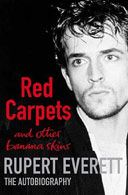
Red Carpets and Other Banana Skins by Rupert Everett

We fancied a bit of an autobiography in my book club - a fun, holiday read, nothing too heavy. But it had to be written by somebody who'd been around long enough to have an interesting life - not a five minute celebrity who'd just won a talent contest. And they had to be able to write, because we didn't want to be cringing over our Christmas cake. Hmm, we're a demanding lot, but we thought we might have found our salvation in Rupert Everett.

Now, Rupert has just brought out Vanished Years, the second instalment of  his autobiography, but we decided to begin at the beginning and opted for Volume One Red Carpets and Other Banana Skins. It was published to great acclaim in 2006 and I was looking forward, as the reviews inside the front cover promised, to an extremely well written wild see-saw ride of stardom.


So did Rupert and his book live up to the hype? Well, I would say, not quite. There's no doubt he writes very entertainingly and his character sketches of present-day icons such as Madonna and Julia Roberts are brilliant. He's adventurous in both his career and personal life - I was amazed to discover the roll call of the famous (of both sexes) that he's slept with. The problem, I suppose, is that I was expecting (as the blurb on the back cover promises) a combination of Evelyn Waugh and Noel Coward, if such a thing can be countenanced. And it's not really Rupert's fault if he's not quite up to that accolade.

It's very enjoyable, let's get that straight. And fascinating to see how the other (rather well-bred) half lives. Rupert seems to have connections everywhere and his version of being broke is not, like mine, surviving on half a mug of rice and an Oxo cube (in student days I hasten to add!) but rather having no money, but still being able to jet round the world courtesy of family friends and doss down for a prolonged period at Tony Richardson's villa in the South of France. His road to discovery up to Another Country is absorbing, but after that, he glides from adventure to adventure, project to project, and I'm afraid I rather lost track. The chronology of the various episodes became a bit confusing and in all the gloss what I missed (with one or two exceptions such as Roddy Mcdowall or  Paula Yates who emerges as a tragically vulnerable figure) was a depth and introspection, an evaluation of the meaningfulness (or otherwise) of his many relationships with family, friends and lovers, the ramifications of being an openly gay actor and the years of drinking and casual drugs. The shadow of AIDS in its infancy lurks in the background so perhaps that's why, when I'd finished the book, despite all the hilarity and high living, I felt somehow saddened.


I saw Rupert Everett on stage years ago in The Vortex, and found him rather impressive. I'd love to see his current performance as Oscar Wilde in The Judas Kiss, which I missed on its pre-West End run in Bath. As I was reading the book, I noticed he was on TV in St Trinian's 2, playing an oddly underwhelming headmistress (Bertie Carvel have no worries). He is one of those performers who can be incredibly good but also profoundly bad - perhaps this is what was meant by the wild see-saw?

All in all, I get the feeling I'm being over-analytical here. He can write. It's great fun. And I expect I'll read the next volume.