
Penelope Fitzgerald came to writing late in life and wasn't published until she was sixty. She made up for lost time though, by winning the Booker Prize in 1979 with Offshore, to the surprise and dismay of many in the literary establishment. In all she had nine novels published, as well as biographies, essays and reviews. The Blue Flower was her last novel, published when she was seventy-nine and winning the National Book Critics Circle Award in the US.
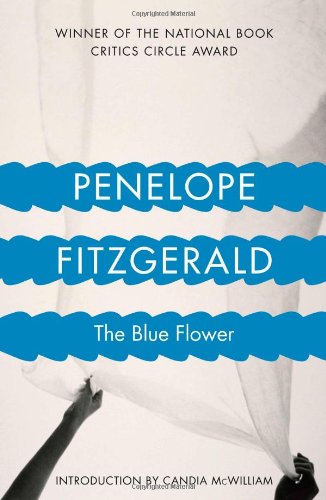
The Blue Flower begins in 1794, a fictionalised account of the younger years of Fritz von Hardenberg, later to become the poet and philosopher Novalis. It's the annual washday at Fritz's Saxon home in Weissenfels, seen through the eyes of his companion Jacob Dietmahler:
Here I am, a stranger to your honoured family, knee deep in your smallclothesWith this striking imagery, we're introduced to Fritz's many siblings, whose numbers are still being augmented regularly by a timid mother and sternly devout father.
The family is noble but far from affluent, rubbing by in a pickle of genteel squalor. Fritz is young and idealistic, influenced by the revolutionary zeal pervading France. Against his father's wishes, he registers to study history and philosophy at university, bringing him into contact with leading thinkers like Schiller, Ritter and the great Goethe. This is a world of new ideas, where the old practice of bleeding a patient to restore health is replaced by 'Brownismus', a prescription of exercise, sex and fresh air, combined with a balance of opium and alcohol.

Fritz's imagination catches what others don't see, but he must earn his living as a tax collector for the salt mines, lodging at the house of a presiding magistrate. On arriving there for the first time, he compliments the magistrate's niece Karoline, in her shawl and housekeeping apron. He's admonished, but replies:
When I came into your home, everything, the wine-decanter, the tea, the sugar, the chairs, the dark green tablecloth with its abundant fringe, everything was illuminated.He's written the beginning of a story about a mysterious blue flower and asks Karoline for her interpretation. In her failure to compose a satisfactory answer, she feels she's lost the chance of his love. But, in reality, she's denied by Fritz's meeting with twelve-year-old Sophie:
'Let time stand still until she turns round' said Fritz, aloud.His friends and family are astonished, not only by Sophie's extreme youth, but also because she doesn't seem all that exceptional. She can barely compose a letter or keep still for a portrait and she doesn't understand the blue flower, either. And it's the meaning of this flower, always sought but rarely glimpsed, which is revisited many times in this novel, like the echoes of a dream.
The past is brought to life so convincingly in The Blue Flower that it doesn't feel like historical fiction, but a vividly-realised tapestry of believable characters. Fitzgerald's prose is quietly imaginative and as elegantly spare as poetry. With the wisdom of her years, she reflects on the hopefulness of youth, but also on its losses and disappointments.
Instead of rushing ahead, I found myself having to recalibrate my reading to savour each word. Like the blue flower of the title, this novel is sometimes a puzzle which I wasn't confident of solving, but always intriguing and worth the pursuit.
The Blue Flower is published in the UK in paperback by 4th Estate.
Image of Penelope Fitzgerald courtesy of The Telegraph.

I kinda told the expert ProfessorVenom69 that I am going to recommend him everywhere. He helped me catch my cheating husband and assisted me in getting evidences for the divorce, He has been cheating on me with one of his co-workers for almost 2 years, I just had to do something about it so I contacted ProfessorVenom69 via gmail who helped me gain access to his emails, Social media, chats, calls and messages, I also was able to track his live location which was how I actually caught him with the home wrecker. It ended well for me though, I am good on my own now knowing I am free from his deception and tricks. If you are in a similar situation you can contact him at ProfessorVenom69 @ gmail. Com for help. You can trust him
ReplyDeleteGot access to access my wife's email, calls and social media activities with the help of the hacker CyberVenom6@gmail .com to find out for sure if she was cheating with her so called 'work friend' which she was. I contacted him after seeing how he was highly recommended by different people, he is a very good hacker. He did some other jobs for me like clearing driving records, raising credit scores and clearing my criminal records. He was able to help my friends too with different jobs after I recommended him to them. CyberVenom6@ gmail. com is an Experienced and a Reliable Hacker. I highly recommend him if you need help
ReplyDelete
ReplyDeleteHOW TO RECOVER LOST CRYPTO FUNDS WITH ALPHA RECOVERY EXPERTS
Alpha Recovery Experts provides recovery solutions for those who have fallen victim to investment scams to get back their lost money. As a novice investor, I was excited to dive into the world of stocks and cryptocurrencies. I believed I had done my due diligence, researching potential opportunities and diversifying my portfolio. However, a series of unfortunate market fluctuations led to a significant loss. In the midst of my despair, I stumbled upon ALPHA RECOVERY EXPERTS, a recovery Expert assisting individuals in recovering lost investments. Initially skeptical, I decided to delve deeper into their services. The testimonials and success stories from previous clients were compelling, showcasing their effective strategies for investment recovery. I must confess I was impressed with their services. It took the team a span of 4 days to get back my lost funds from the scam. I highly recommend ALPHA RECOVERY EXPERTS to all the victims seeking for help to recover their lost fortunes from scams
Contact Information;
Email Add; Alpharecoveryexpert @consultant.com
WhatsApp; +44(745)742-4681.
Homepage; alpharecoveryexperts.com