Thursday, 28 May 2015

Theatre Review: Mmm Hmmm at Theatre Shop, Clevedon

This review was first written for The Public Reviews


Mmm Hmmm was a word-of-mouth hit when performed in Bristol’s Tobacco Factory last year, and for those who missed Verity Standen’s a capella song theatre, the show’s visit to Theatre Shop’s inaugural season in Clevedon provides a welcome opportunity to catch up.
This really is a genre-defying piece, combining three stunning female voices: Standen herself in collaboration with Ellie Showering and Dominie Hooper. Their vocals harmonise closely before breaking apart, sharing words and syllables one at a time as though playing a story-telling game whose ending can only be guessed at. There is sheer power here but also subtlety; perfect timing but also the courage to exploit the breaks between songs, creating what might be silence but for the deliberately raw sounds of breathing as the trio recover for what is yet to come.
Mmm Hmmm has no real narrative but offers a series of vignettes of modern life: very British apologies for minor public infringements and a Gregorian chant encompassing a litany of malaises – an incorrectly-typed password, the swiping of a Nectar card, a debit card declined. The limitations of the First Great Western buffet car and its garbled tannoy announcements resonate. There is a tribute to lost love too, which, of course, demands the eating of biscuits and portrays the comically alarming outcome – especially for the audience in the front row – of singing with your mouth full.
Playful or mournful, the impact is not only aural. Mmm Hmmm is visually arresting, the three performers kitted out in Harriet de Winton’s contrasting block-coloured jersey dresses with sleeves and hoods which adapt to hug or disguise the body. While singing they bounce and jostle around the stage, crowding into each other with the tensions of the everyday struggle to survive.
The theatricality builds wave upon wave of sound in a startlingly original and mesmerising world which, once entered, is not easily forgotten. This may be a show of only fifty minutes duration, but it’s time enough nevertheless to reach out and touch upon the soul.
Reviewed on 16th May 2015 | Photo: Paul Blakemore

Theatre Review: Frantic – Queen’s Square Street Theatre, Clevedon

This review was first written for The Public Reviews


Theatre Shop’s season in Clevedon includes not only professional live performance in an empty retail unit, but also a variety of free street entertainment. Ballet Central danced on the pier to an audience of 700, a jester tumbled colourfully along the prom and a giant-sized game of live hangman was open to everyone.
To this eclectic mix, contemporary dance and circus company Acrojou bring their latest show Frantic, a combination of acrobatics, dance and physical theatre choreographed around a bespoke tubular wheel with a chair fixed in its centre. One man is trapped by his busy world inside the wheel, running and typing manically on a keyboard. A blind flickers open before shuttering him in again as he is first observed and then helped outside by a young woman.
His movements are frenetic, hers repetitive and controlled, until she helps him to escape and unleashes an elemental expression of emotion in sand and water. There follows fluid freedom of movement outside the wheel, a discovery of love and harmony for them both, culminating in a cathartic rainstorm to mesmerising music.
This short twenty minute piece is slow to catch light – which risks losing the attention of a mobile audience – but intriguing when it does. It creates a narrative without words that invokes echoes of Gecko’s Institute and showcases Acrojou as a company to watch.
Reviewed on 16th May 2015 | Photo: Pete Axford

Theatre Review: The Devil and the Shopkeeper at Theatre Shop, Clevedon

This review was first written for The Public Reviews

There’s something thrilling transforming the seaside town of Clevedon this month, with the inaugural season of Theatre Shop, an empty retail unit on a pleasant square, reborn as a venue for professional live performance.
Bristol-based Living Spit is one of the creative forces behind this reinvention, as well as a major player in the theatre’s programming. Not only are they involved in presenting Living Quiz, a theatrical-style pub quiz, and their show One Man and his Cow, they also perform in Parts 1 and 2 of their retail-themed caper The Devil & The Shopkeeper.
Told with Living Spit’s trademark combination of rhyming couplets, silly songs and live music, with a cardboard cash register teetering on a counter of empty fruit crates, The Devil & The Shopkeeper recounts the woes of independent store-owning Jeremiah Brown to a packed and expectant family audience.
Jeremiah’s small shop was once the thriving hub of the community, catering to all possible tastes and requirements. Who knows when you might need a hat with a light on it? But recently, he’s been losing out to the new superstores moving into town and now he hasn’t made a sale in weeks. Cue the entry of a mysterious stranger offering to bring hordes of customers flocking back to his door. But his contract comes at very high price and may not be quite the bargain that Jeremiah was expecting.
Howard Coggins and Stu Mcloughlin unfold their tale with energy and freshness – despite this being their third show of the day, there’s no sign of flagging. Words are cleverly crafted and there’s great musical agility on display – from double bass to ukulele. Coggins is endearing as the put-upon shopkeeper and Mcloughlin suitably menacing – in true pantomime-villain style – as the visiting devil. With little in the way of lighting and special effects – a solitary red light and the odd puff of dry ice – in the daylight of the intimate shop surroundings, they make very effective use of space; strutting out of the shop door to the bemusement of passers by, who also peer in through uncurtained windows from time to time to see what all the fun’s about.
Part 1 wraps up with a very silly and satisfying conclusion and Part 2 continues Jeremiah’s story as the devil – having exposed a hitherto unsuspected weakness – returns with another dastardly plan.
This is a tautly-written, lively and fun-filled sixty minutes of family entertainment. Its enthusiastic reception suggests that, in bringing the best of Bristol to a wider north Somerset audience, Theatre Shop is providing a hugely diverting distraction from the joys – or otherwise – of real-life shopping.
Reviewed on 16th May 2015.

Sunday, 24 May 2015

Book Review: Unravelling Oliver by Liz Nugent

I expected more of a reaction the first time I hit her. She just lay on the floor holding her jaw. Staring at me. Silent. She didn't even seem to be surprised.
Quite an opening paragraph. And having grabbed your attention, Liz Nugent's debut novel Unravelling Oliver doesn't let go for a second. There's never any question who did it - the puzzle is why.


Oliver and Alice have an apparently happy marriage. He's a successful author of children's books and she's his illustrator. But there are clues early on (apart from that opening paragraph, of course) that all is not well.
I had always been fond of her in my way. She was a marvellous cook, for example, after all the gourmet cuisine courses I made sure she attended. Also, she could be very athletic in bed, which was nice.
Not exactly a meeting of souls, this marriage then. Oliver's is the ice-cold voice of detachment, the potential serial killer with more than one secret waiting in the wings. Something tells you he hasn't had a happy, conventional childhood - a suspicion which hardens into fact as his story unfolds.

After Oliver's opening chapter the viewpoint shifts - amongst others to Alice's childhood sweetheart Barney, Oliver's university friend Michael and Véronique, owner of the chateau where events occurred to change the course of so many lives.The narrative skirts in ever decreasing circles, with each testimony offering a different insight that closes ever more tightly in on the truth, before returning to Oliver. The only person conspicuous by her absence is Alice - and she no longer has a voice.

Unlike many multiple viewpoint narratives, where some characters are more authentic than others, Nugent is skilled in capturing each of these voices - so that they feel distinctly different and believable. It's possible to empathise with them all - even Oliver - because each has their own backstory and, as they fit another piece into the jigsaw, the reader must decide upon their reliability (or otherwise) as narrators. And pick the threads of fact from the protective cloak which each character may be putting on the past - unravelling the twists and turns which have you guessing right up to the satisfying conclusion.


I've heard this novel - like so many others - referred to as the next Gone Girl, but if - like me - you disliked Gillian Flynn's bestseller then don't be put off. With Gone Girl, I objected to the way I was being manipulated as a reader, neither did I find its tone nor characters credible. Unravelling Oliver is of a different order altogether.

Liz Nugent has worked in Irish film, theatre and television for most of her adult life and it's easy to imagine this tense and thrilling debut transferring to the screen. At only just over 200 pages it's possible to read Unravelling Oliver in just one or two sessions and be warned, once you begin, you'll probably feel compelled to do so.

Thanks to Penguin for my review copy. Unravelling Oliver is now available in paperback here. Photo of Liz Nugent by Ronan Lang.

Theatre Review: Tartuffe at the Tobacco Factory Theatre, Bristol

This review was first written for The Public Reviews


First performed in Versailles in 1664, Molière's Tartuffe was banned soon afterwards by King Louis XIV because of its display of religious hypocrisy and its confusion of virtue and vice. In today’s more secular society, it’s possibly harder to take the same offence on religious grounds, but still easy to recognise the bounder Tartuffe for the self-serving weasel that he is.
Following on from Shakespeare at the Tobacco Factory’s triumphant production of Sheridan’s The School for Scandal, we have another period piece in the Factory Theatre reminding us of the unchanging nature of human duplicity. Kelvin Players, a long established amateur group in Bristol, have updated their first production here from Molière’s seventeenth century comedy to the 1890s, with a well-dressed set and cast sumptuously costumed in a hybrid style of Restoration fabrics and colours combined with late Victorian silhouettes.
Orgon has fallen under the spell of Tartuffe, a former vagrant he has raised from the gutter. So much so that he seems to care about him more than his own wife and children, believing in Tartuffe’s religious piety and devotion, even when there’s evidence to the contrary. Orgon’s mother, the venerable Madame Pernelle, is similarly afflicted, but the rest of his family is not. They see Tartuffe for what he is; a self-serving hypocrite with his eye on Orgon’s wife and fortune.
Kelvin Players’ production takes time to establish itself, getting off to a slow start, apart from an impressive initial set piece of the household processing to church, during which Orgon first claps eyes on Tartuffe. There’s philosophising and exposition to get through and, despite a consistent fluency in delivering lines, occasionally a lack of variety of pace leads to their rhythm and humour being lost.
When Orgon seeks to break off his daughter’s betrothal to Valère so that she should be promised to Tartuffe instead, the family know they must act. But will they be in time to rescue Mariane from a marriage made in hell and Orgon from bequeathing away his fortune? Orgon’s wife Elmire and son Damis, together with the family’s maid Dorine are certainly going to give it their best shot and this is where the company gets into its stride.
Tom Colebrook is a convincing Tartuffe and there are other strong performances amongst the cast, especially from the women; Nicky Rope as Elmire, Fiona McClure as Dorine and Christine West as a formidably Angela Lansbury-esque Madame Pernelle all excel. It’s hard to imagine a Victorian family maid being as assertive as Dorine though, or a Victorian wife as openly seductive to another man as Elmire, and here the updated setting does seem to sit uneasily with the play.
Ralf Togneri’s direction capitalises on the increased action of the second half, and with particularly engaging exchanges between Tartuffe and Elmire, it bowls along nicely to a satisfying conclusion. This is an enjoyable exploration of a classic text and much credit goes to the hard work of the Kelvin Players that enables them to be judged by the same standards as a professional company.
Reviewed on 13th May 2015. Photo: McPherson Photography.

Theatre Review: The Absence of War (election week special) at the Theatre Royal, Bath

This review was first written for The Public Reviews


David Hare’s forensic examination of the recurring electoral misfortunes of the Labour Party, loosely based on events surrounding the 1992 election, ends its 2015 tour with an election week stopover in Bath.
Originally staged back in 1993, The Absence of War follows the fortunes of George Jones, a man who has risen from humble beginnings to become Labour’s leader, but not without sacrificing some of his own spontaneous passion to get there. Privately charismatic, in public – shackled by advisers into staying strictly on message – he polls as “boring”. Even his own backbenchers are losing faith. As his antagonist, Shadow Chancellor Malcolm Pryce, remarks,  “it isn’t the party doesn’t believe in you, they smell you don’t believe in yourself.”
In 1992 it was Neil Kinnock as Labour’s leader who failed to become Prime Minister, but in Headlong’s revival, staged in association with Sheffield Theatres and Rose Theatre Kingston, George’s inability to convey his personal passions to the electorate could foreshadow the problems of Ed Miliband. His difficult relationship with Malcolm anticipates the internal power struggle of the Blair/Brown years and the obsession of his unelected advisers with focus groups and keeping on message encapsulates so much of what still alienates many voters today.
The landscape of the 1990s is reflected in bulky TV screens showing Ceefax headlines and news, communication by pager, smoking in the office and a reference to Pebble Mill. Yet Hare’s incisive writing frequently holds just as much of a mirror to our own society as it did over twenty years ago; reflecting the establishment’s predilection for looking after its own and raising questions of authenticity versus electability, the corrosive ruthlessness needed to grasp power and the vacuum that exists without a unifying enemy force to provide a common purpose.
Reece Dinsdale as George captures all the complexity of a man at odds with himself: confident yet full of self-doubt, striving for power yet imprisoned by its pursuit. Trevor Fox recently stepped successfully into this role at short notice due to Dinsdale’s illness and it was hard to see how his performance could have been bettered. Yet Dinsdale does, quite simply, take back full ownership and his interpretation is phenomenal.
The rest of the cast is equally strong. Gyuri Sarossy delivers a finely nuanced performance as Malcolm, the next leader in waiting, particularly in his aircraft hangar showdown with George. Cyril Nri is calculating and efficient as political adviser Oliver Dix, Charlotte Lucas’ publicity chief Lindsay Fontaine fluently spouts focus group percentages and Maggie McCarthy is indefatigably down to earth as George’s diary secretary Gwenda.
Using coloured backdrops, projection and silhouettes to great effect, under Jeremy Herrin’s direction, the production captures the maelstrom of election campaigning in all its frenetic energy.
In this its final week, The Absence of War is honed to perfection, as much a reflection of our contemporary dilemmas as it is a period piece. On election night 2015, David Cameron and Ed Miliband might be wishing for an outcome like we used to have – with one of two parties emerging the clear winner. Tickets for Thursday 7th May are available at 1992 prices – how better to be reminded of the triumph and despair that awaits our political leaders than to catch this coruscating production as the polls close.
Reviewed on 5th May 2015.

Friday, 15 May 2015

Reading the Classics: Dr Zhivago by Boris Pasternak

I have to confess to never having read Dr Zhivago before - nor even seen the film.

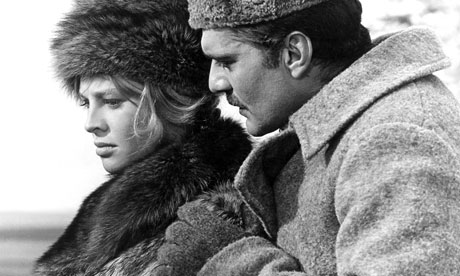
Most people I mention this to are incredulous - at least as far as the film is concerned. Never swooned over Omar Sharif? Longed to be Julie Christie? Been swept away by the rousing music and panoramic landscapes? Even my husband of 23 years is now looking at me in a new - and rather quizzical - light.


But I don't want to see the film until I've read the book, you see.

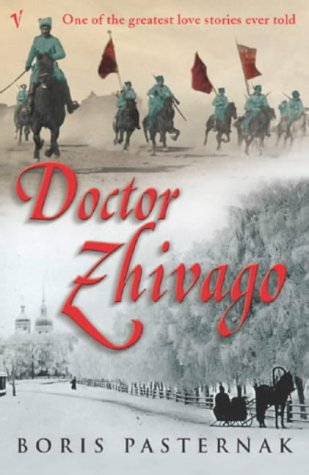
So when we picked it as our next book club choice, I was relieved to finally have an unassailable reason to get to grips with Boris Pasternak's 1957 classic of Russian literature. A quick consultation on Twitter - the kind of instant discussion that it's made for - decided the best choice of translation, with the original Hayward/Harari version winning out over the more recent Pevear/Volokhonsky, which Pasternak's niece took such a dislike to.


Dr Zhivago begins in Imperial Russia in 1903, with the funeral of Yury Zhivago's mother. The boy's father has long been absent, so Yury is first taken in by his uncle Kolya, before settling down with the Gromekos in Moscow. He becomes close to Tonya, the daughter of the family, soon to be his wife. Then, against a background of widespread civil unrest and hardship, he first sets eyes on Lara.

Her desperate mother is being treated in a Moscow hotel and Lara is asleep in an armchair, until disturbed by the family lawyer Komarovsky:
Not a word passed their lips, only their eyes met. But the understanding between them had a terrifying quality of black magic, as if he were the master of a puppet show and she were a puppet obedient to his every gesture. 
A tired smile puckered her eyes and loosened her lips, but in answer to his amused glance, she gave him a sly wink of complicity. Both of them were pleased that it had all ended so well - their secret was safe and Madame Guishar's attempted suicide had failed.
Yura devoured them with his eyes. From the half darkness of the lobby where no one saw him he stared unblinking into the circle of lamplight. The scene between the captive girl and her master was both incommunicably mysterious and shamelessly frank. New and conflicting feelings crowded painfully in Yura's heart.
Lara goes to great lengths to escape Komarovsky's malevolent hold over her - marrying Pasha Antipov, her childhood friend, and moving far from Moscow. But her path is destined to cross Yury's again. After the outbreak of the First World War, she trains to be a nurse and is stationed in the town where he is now a qualified doctor in the ranks of the army. At the height of the revolution, they part only for fate to bring them together once again, forcing Yury to face up to the conflict of his love for both Lara and his wife and family.


The narrative ranges over thousands of miles - usually by epic train journey. Yet there are connections within connections within connections. Lara can never fully free herself from Komarovsky, who was also complicit in the death of Yury's father. Yury has more than one encounter with Lara's husband in his various incarnations. The book contains a huge and widely dispersed cast of characters - from Tiverzin the trade unionist in Moscow to Liberius, leader of the Forest Brotherhood - but they are often related to each other and make such breezily coincidental reappearances, that at times they seem more like the inhabitants of a small town, than the vast, empty swathes of revolutionary Russia.

And yet, this is the point; Pasternak places his characters where he can use them best to capture momentous events. So Yury tells Lara that
the whole of Russia has had its roof torn off, and you and I and everyone else are out in the open! 
Back in Moscow, he witnesses the coming of this revolutionary new order for himself when, in the midst of a snowstorm, he buys a paper from a newsboy:
Yury stopped under a street light to read the headlines. The paper was a late extra printed, on one side only; it gave the official announcement from Petersburg that a Soviet of People's Commissars had been formed and that Soviet power and the Dictatorship of the Proletariat were established in Russia...
The blizzard slashed at Yury's eyes and covered the printed page with a grey, rustling, snowy gruel but it was not the snowstorm that prevented Yury from reading. He was shaken and overwhelmed by the greatness of the moment and the thought of its significance for centuries to come.
That is not to say the novel isn't rich in characterisation. Yury is described as not especially good-looking, but with a lively intelligence about him. He's a poet as well as a doctor, thinker and philosopher who's never willing to accept an opinion for the sake of expedience. When he and his family come under suspicion for belonging to the old ruling classes, they escape to Tonya's former family estate in the Ural mountains and there he pours his thoughts into an exquisite diary which breaks off all too abruptly.

Lara is beautiful but enigmatic. Her relationship with Komarovsky is never fully explained, but is easy to speculate about. And he certainly has a hand in her fate throughout the novel, influencing her from first to last. But it is her love for Yury that changes her world as much as his:
They loved each other greatly. Most people experience love, without noticing that there is anything remarkable about it. 
To them - and this made them unusual - the moments when passion visited their doomed human existence like a breath of timelessness were moments of revelation, of ever greater understanding of life and of themselves.
Such exquisite language, such glimpses into the human soul, reward all the grappling with names, patronymics and diminutives that the book demands. Many names have resonances which can’t be translated; the word 'zhiv' (alive, living) is clear in Zhivago, while Komarovsky contains the Russian for mosquito.


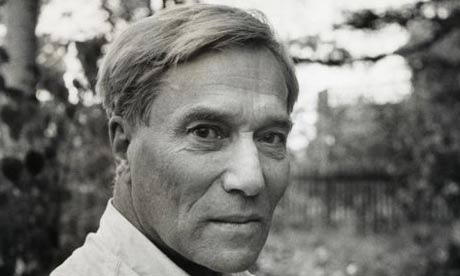
Having smuggled the novel out of the Soviet Union and published it in Italy, Pasternak was awarded the Nobel Prize for Literature in 1958, but was forced to decline it by the Communist state which objected to his interpretation of their rise to power. And yet, Dr Zhivago is not only a love story on a personal level, but also a tribute to Mother Russia with all her flaws.

In this way, I'm told, it's different from the film which concentrates much more on the love triangle between Yuri, Tonya and Lara. Now that I've read the book, I can finally watch it myself and find out.


Dr Zhivago (translated by Max Hayward and Manya Harari) is published in the UK by Vintage Classics. Photos courtesy of Amazon and the Guardian.